
Artificial Intelligence (AI agents) are revolutionizing industries — from customer service to scientific research. But building AI agents that are effective, reliable, and safe requires more than just machine learning models. It demands clear design principles, intelligent memory handling, modularity, and robust safety guardrails.
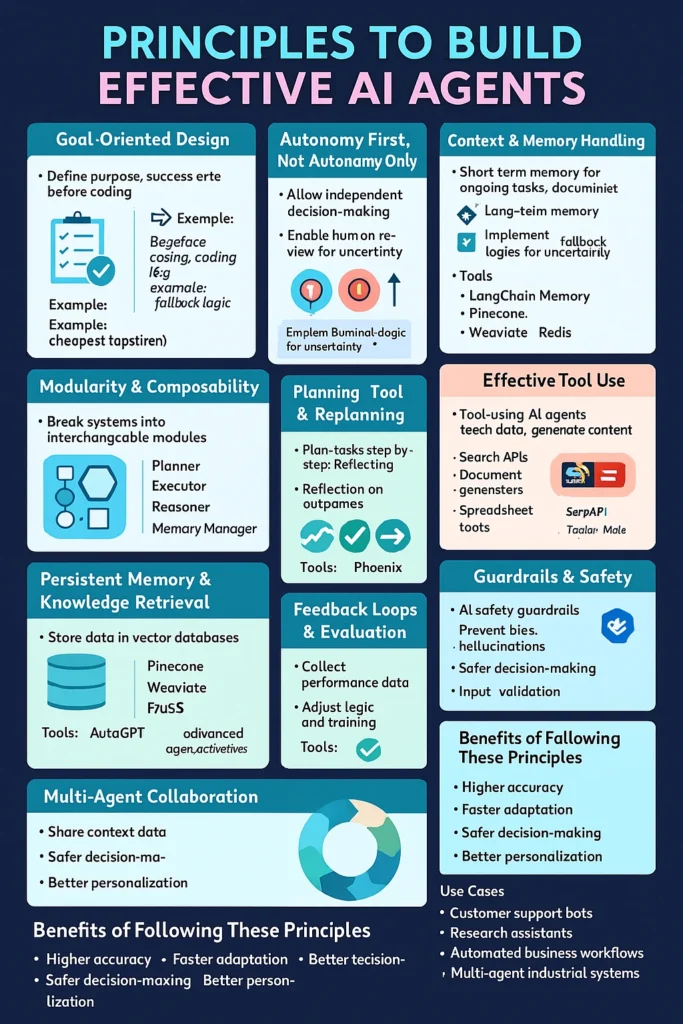
This guide explains the 11 key principles for building AI agents, We’ll cover definitions, how they work, benefits, use cases, and responsible AI practices.
What is an AI Agent?
An AI agent is a system that perceives its environment, processes data, and takes action to achieve specific goals. These autonomous AI systems can:
- Understand and remember context.
- Make decisions without constant human input.
- Use tools and APIs to expand capabilities.
- Collaborate with other AI agents or humans.
The aim is to build AI agents that are goal-oriented, adaptive, and trustworthy.
1. Goal-Oriented Design
Goal-oriented design ensures every AI agent operates with a clear objective. Before coding:
- Define the purpose.
- Set success metrics.
- Plan the completion steps.
Example:
A travel assistant agent’s goal could be: “Book the cheapest flight from NYC to London in September.”
Why It Matters:
Goal-focused them avoid wasted computation and stay aligned with user needs.
2. Autonomy First, Not Autonomy Only
Autonomous AI should take initiative but also involve humans when necessary.
- Allow independent decision-making.
- Enable human review for sensitive cases.
- Implement fallback logic for uncertainty.
Best Practice: Keep humans in the loop for ethical or high-impact choices.
3. Context & Memory Handling
To make context-aware decisions, AI agents need:
- Short-term memory for ongoing tasks.
- Long-term memory for historical data, documents, and past interactions.
Tools: LangChain Memory, Pinecone, Weaviate, Redis.
Benefit: Stronger personalization and more accurate responses.
4. Modularity & Composability
Breaking AI systems into interchangeable modules improves flexibility and scalability.
Modules may include:
- Planner
- Executor
- Reasoner
- Memory Manager
- Feedback Loop
Tools: AutoGen, LangGraph.
Advantage: Easier debugging, updates, and performance optimization.
5. Planning, Reflection & Replanning
An effective AI agent doesn’t just act — it strategizes.
- Plans tasks step-by-step.
- Reflects on outcomes.
- Replans if conditions change.
Tools: AutoGPT, advanced agent architectures.
6. Effective Tool Use
Tool-using them can fetch data, generate content, and automate workflows.
- Search APIs
- Document generators
- Spreadsheet tools
Tools: SerpAPI, PDF Readers, Zapier, Make.
7. Persistent Memory & Knowledge Retrieval
Persistent memory allows AI agents to learn over time.
- Store in vector databases.
- Retrieve relevant facts instantly.
Tools: Pinecone, Weaviate, FAISS.
8. Feedback Loops & Evaluation
To keep improving:
- Collect performance data.
- Adjust logic and training.
Tools: Trulens, Phoenix.
9. Guardrails & Safety
AI safety guardrails prevent bias, hallucinations, and harmful outputs.
- Structured output formats (JSON/XML).
- Input validation.
- Content filtering.
Tools: Guardrails AI, OpenAI JSON Mode.
10. Multi-Agent Collaboration
Multi-agent systems share knowledge and coordinate tasks.
- Assign specialized roles.
- Share context data.
- Use collaboration protocols.
Tools: CrewAI, Microsoft AutoGen.
11. Key Tooling Stack
A strong AI agent stack includes:
- Frameworks: LangChain, AutoGen.
- LLMs: GPT-4, Claude, Gemini.
- Vector DBs: Pinecone, Weaviate, FAISS.
- Guardrails: Guardrails AI, JSON validators.
Benefits of Following These AI Agent Principles
- Higher accuracy.
- Faster adaptation.
- Safer decision-making.
- Better personalization.
Use Cases
- Customer support bots.
- Research assistants.
- Automated business workflows.
- Multi-agent industrial systems.
Responsible AI Considerations
When building AI agents:
- Reduce bias with diverse training data.
- Ensure transparency.
- Protect privacy.
- Maintain human oversight.
Conclusion
The future of AI lies in well-designed, safe, and adaptable agents. By following these principles—goal orientation, modularity, context awareness, safety guardrails—you can build AI agents that deliver real-world impact with responsible AI practices.
FAQ: Building Effective AI Agents
Q1: What’s the most important AI agent design principle?
A: Goal-oriented design ensures focus and measurable success.
Q2: How do they handle long-term memory?
A: Through vector databases like Pinecone or Weaviate.
Q3: Why use modular AI agent architecture?
A: For scalability, easier updates, and better debugging.
Q4: How can you keep AI agents safe?
A: By adding guardrails, validators, and structured output formats.
Q5: Can multiple AI agents work together?
A: Yes, multi-agent collaboration allows task specialization and faster execution.